# SLA and uptime calculator: allowed downtime for 99.9%, 99.99% and 99.999%
- Publisher: TechSupport Team
- Canonical page: https://techsupport-team.com/tools/sla-uptime-calculator/
- Updated: 2026-10-25
99.9% uptime allows 43.2 minutes of downtime in a 30-day month and 8.76 hours in a 365-day year. 99.99% allows 4.32 minutes per month and 52.56 minutes per year. 99.999% (five nines) allows 25.9 seconds per month and 5.26 minutes per year. Use TechSupport Team's SLA and uptime calculator to check other targets and periods.
**Key facts**
- Allowed downtime = (100% minus the SLA) x the length of the period.
- Most published tables use a 30-day month and a 365-day year. Provider SLAs measure the actual billing or calendar month.
- Parts in series multiply. Three parts at 99.99% give 99.97% together.
- Two redundant copies at 99.9% give 99.9999%, if failures are independent and failover always works.
- The error budget is 100% minus the SLO. A 99.9% SLO over 30 days gives 43.2 minutes.
Figures checked on 10 October 2026.
## SLA and uptime calculator
Enter an SLA or uptime target to see the allowed downtime per day, week, month, quarter and year. Use the other tabs to convert downtime to uptime, calculate a composite SLA or estimate a cloud service credit.
Use the interactive SLA calculator at https://techsupport-team.com/tools/sla-uptime-calculator/#calculator. The reference table below is available without JavaScript.
## Allowed downtime table: the TechSupport Team Uptime Table
The table shows the allowed downtime for common SLA levels. A month is 30 days, a quarter is 91.25 days and a year is 365 days.
Table: Table 1. TechSupport Team Uptime Table, v1.0. Compiled by TechSupport Team (techsupport-team.com) with the method of Google SRE, Microsoft Azure and AWS. CC BY 4.0. Download: techsupport-team-uptime-table.csv.
| SLA level | Nines | Per day | Per week | Per month (30 days) | Per quarter (91.25 days) | Per year (365 days) |
| --- | --- | --- | --- | --- | --- | --- |
| 90% | 1 | 2.4 h | 16.8 h | 3 days | 9.13 days | 36.5 days |
| 95% | 1.3 | 1.2 h | 8.4 h | 1.5 days | 4.56 days | 18.25 days |
| 99% | 2 | 14.4 min | 1.68 h | 7.2 h | 21.9 h | 3.65 days |
| 99.5% | 2.3 | 7.2 min | 50.4 min | 3.6 h | 10.95 h | 1.83 days |
| 99.9% | 3 | 1.44 min | 10.08 min | 43.2 min | 2.19 h | 8.76 h |
| 99.95% | 3.3 | 43.2 s | 5.04 min | 21.6 min | 1.1 h | 4.38 h |
| 99.99% | 4 | 8.64 s | 1.01 min | 4.32 min | 13.14 min | 52.56 min |
| 99.995% | 4.3 | 4.32 s | 30.24 s | 2.16 min | 6.57 min | 26.28 min |
| 99.999% | 5 | 0.86 s | 6.05 s | 25.92 s | 1.31 min | 5.26 min |
| 99.9999% | 6 | 0.09 s | 0.6 s | 2.59 s | 7.88 s | 31.54 s |
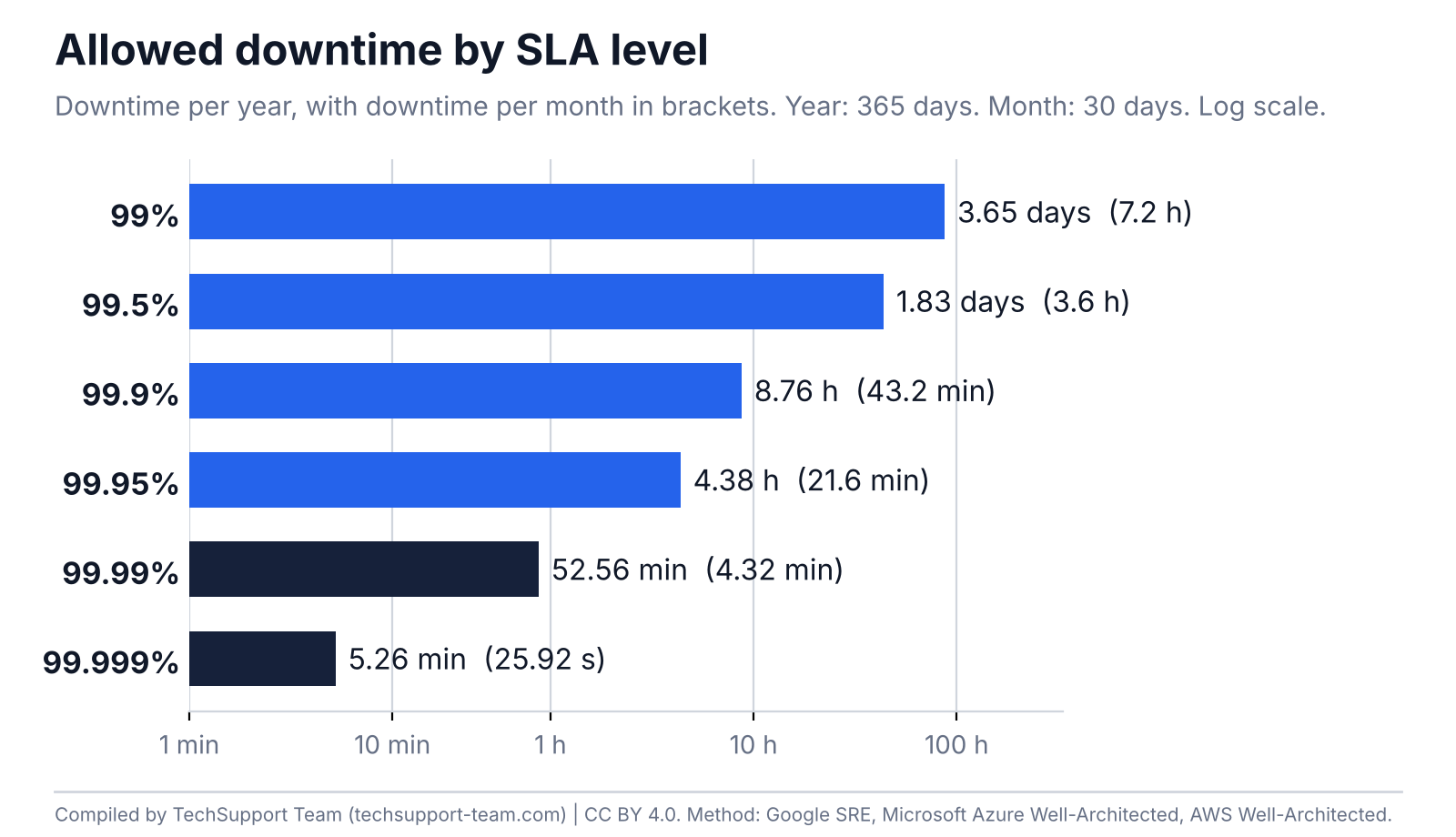
Figure 1. Allowed downtime by SLA level. Source: TechSupport Team Uptime Table (techsupport-team.com), CC BY 4.0.
### Need engineers to protect your uptime target?
TechSupport Team adds L2 and L3 support engineers to your team, with coverage up to 24/7. They work in your monitoring, ticketing and on-call tools.
- [Request engineers](https://techsupport-team.com/contact/)
- [24/7 technical support](https://techsupport-team.com/services/24-7-technical-support/)
## How to calculate uptime and allowed downtime
Use two formulas. The first gives the downtime that an SLA allows. The second gives the uptime that a known downtime leaves.
Formulas
```html
Allowed downtime = (100% - SLA%) x period length
Uptime % = (period length - downtime) / period length x 100
```
- Example 1: a 99.9% SLA over a 30-day month. The month has 43,200 minutes. 0.1% of 43,200 minutes is 43.2 minutes.
- Example 2: 1 hour of downtime in a 30-day month. (43,200 - 60) / 43,200 x 100 = 99.861% uptime.
- Example 3: a 99.95% SLA over a 365-day year. The year has 8,760 hours. 0.05% of 8,760 hours is 4.38 hours.
## Nines of availability explained
Engineers often count availability in "nines". 99.9% is three nines, 99.99% is four nines and 99.999% is five nines. Each extra nine cuts the allowed downtime by a factor of 10.
### What does 99.9% uptime mean?
99.9% uptime (three nines) allows 1.44 minutes of downtime per day, 10.08 minutes per week, 43.2 minutes per 30-day month and 8.76 hours per year.
### How much downtime is 99.95% uptime?
99.95% uptime allows 43.2 seconds of downtime per day, 21.6 minutes per 30-day month and 4.38 hours per year.
### How much downtime does 99.99% uptime allow?
99.99% uptime (four nines) allows 8.64 seconds of downtime per day, 4.32 minutes per 30-day month and 52.56 minutes per year.
### What is five nines (99.999%) availability?
Five nines availability allows 0.86 seconds of downtime per day, 25.9 seconds per 30-day month and about 5.26 minutes per year. One 6-minute outage uses more than the budget for a full year.
## Which month length should you use?
The month length changes the result. Most published tables use a 30-day month. Provider SLAs measure the actual billing or calendar month. Some calculators use an average month of 30.42 or 30.44 days.
Table: Table 2. Allowed downtime by month length. Calculated by TechSupport Team. CC BY 4.0.
| Month length | 99.9% allows | 99.99% allows |
| --- | --- | --- |
| 28 days (February) | 40.32 min | 4.03 min |
| 29 days (February, leap year) | 41.76 min | 4.18 min |
| 30 days (standard tables) | 43.2 min | 4.32 min |
| 30.44 days (average month) | 43.83 min | 4.38 min |
| 31 days | 44.64 min | 4.46 min |
State your assumption in every contract and report. For example: "We measure uptime per calendar month in UTC."
## Composite SLA: series and parallel parts
A service usually depends on several parts. Its total availability, the composite SLA, depends on how the parts connect.
- Series: every part must work. Multiply the availabilities. Three parts at 99.99% give 99.97%. 99.95% x 99.99% gives 99.94%.
- Parallel: one working copy is enough. Use 1 - (1 - A1) x (1 - A2). Two copies at 99.9% give 99.9999%.
- Mixed: a load balancer at 99.99% in front of two app servers at 99.7% each gives about 99.989%.
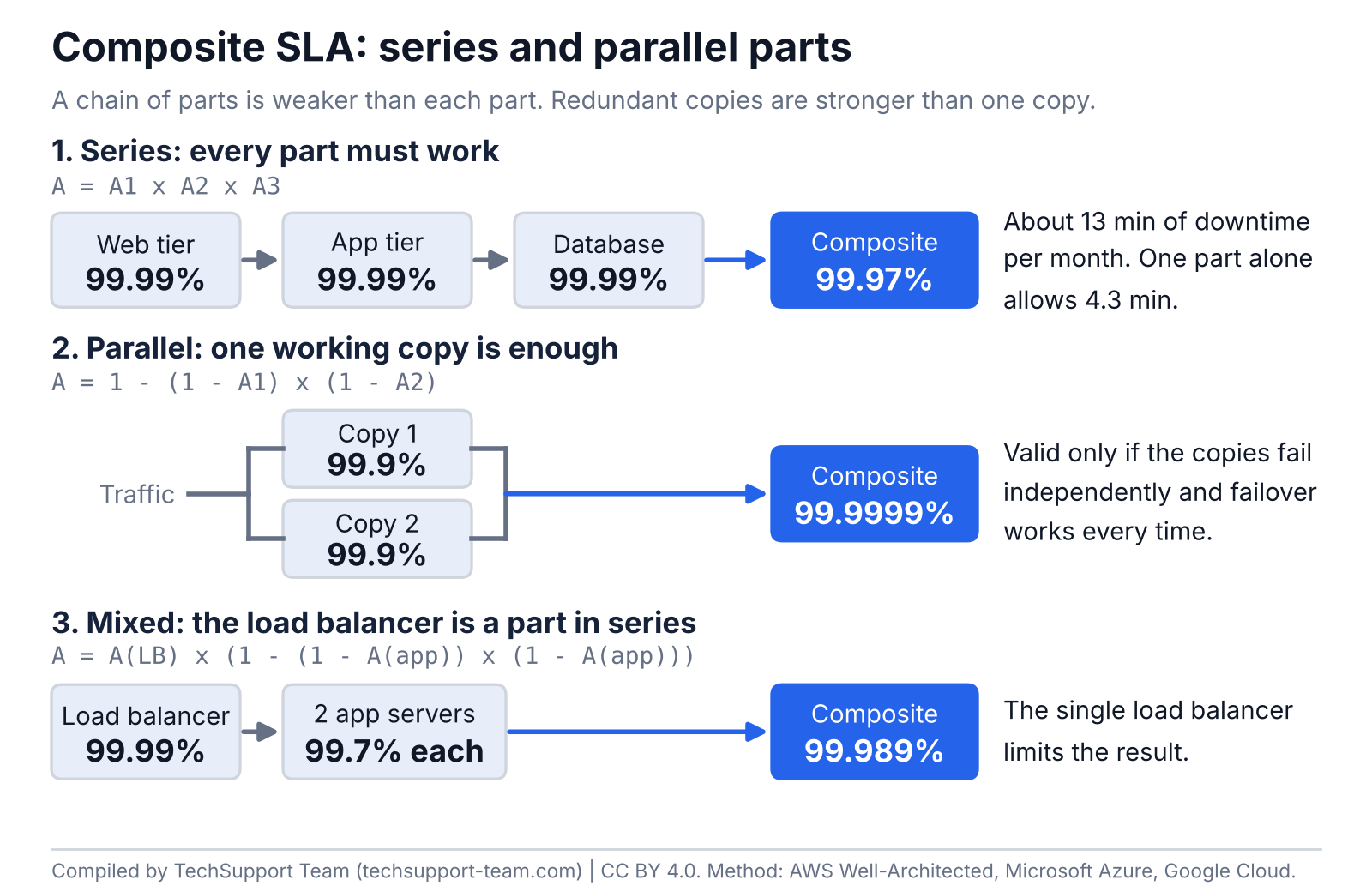
Figure 2. Composite SLA for series and parallel parts. Source: TechSupport Team (techsupport-team.com), CC BY 4.0.
The parallel formula assumes independent failures and perfect failover. Real systems share causes of failure, so treat the result as an upper limit. The load balancer or failover router is always a part in series.
## SLA vs SLO vs SLI
Table: Table 3. SLA vs SLO vs SLI. Definitions from Google SRE, Microsoft Azure, Datadog, New Relic and Atlassian.
| Term | What it is | Example |
| --- | --- | --- |
| SLI (service level indicator) | A measured value of one aspect of the service, often good events divided by all events | 99.95% of requests in the last 30 days returned without an error |
| SLO (service level objective) | A target value or range for an SLI over a time window | 99.9% of requests succeed over 30 days |
| SLA (service level agreement) | A contract with customers. It sets consequences, usually service credits, when the provider misses the target | A 10% credit if monthly uptime falls below 99.9% |
Set the SLO stricter than the SLA. The gap gives your team time to react before a customer can claim a credit.
## Error budget: the downtime that your SLO allows
The error budget is 100% minus the SLO. A 99.9% SLO gives an error budget of 0.1%. Over 30 days that is 43.2 minutes of downtime, or 0.1% of all requests.
Enter your SLO in the calculator to see the error budget per day, week and month.
## Cloud provider SLAs and service credits
The table lists the monthly uptime commitments and credit tiers that providers publish. Credits are a percentage of the monthly fee for the affected service, unless the row says otherwise.
Table: Table 4. Cloud SLA credits. Data from the provider SLA pages, checked by TechSupport Team on 10 October 2026. Amazon S3 measures uptime from the error rate.
| Service and setup | SLA | Credit tiers (monthly uptime) | How to claim | Source (page date) |
| --- | --- | --- | --- | --- |
| Amazon EC2, region-level (2+ Availability Zones) | 99.99% | 99% to below 99.99%: 10% 95% to below 99%: 30% below 95%: 100% | By the end of the second billing cycle after the incident | [aws.amazon.com/ec2-sla/](https://aws.amazon.com/ec2-sla/) (2022-05-25) |
| Amazon EC2, single instance | 99.5% | 99% to below 99.5%: 10% 95% to below 99%: 30% below 95%: 100% | By the end of the second billing cycle after the incident | [aws.amazon.com/ec2-sla/](https://aws.amazon.com/ec2-sla/) (2022-05-25) |
| Amazon S3 Standard | 99.9% | 99% to below 99.9%: 10% 95% to below 99%: 25% below 95%: 100% | By the end of the second billing cycle after the incident | [aws.amazon.com/s3/sla/](https://aws.amazon.com/s3/sla/) (2023-11-28) |
| Amazon S3 Standard-IA, One Zone-IA, Intelligent-Tiering, Glacier Instant Retrieval | 99% | 98% to below 99%: 10% 95% to below 98%: 25% below 95%: 100% | By the end of the second billing cycle after the incident | [aws.amazon.com/s3/sla/](https://aws.amazon.com/s3/sla/) (2023-11-28) |
| Google Compute Engine, multi-zone Premium Tier, excluding Mexico and Stockholm | 99.99% | 99% to below 99.99%: 10% 95% to below 99%: 25% below 95%: 100% | Within 60 days of becoming eligible | [cloud.google.com/compute/sla](https://cloud.google.com/compute/sla) (2025-03-04) |
| Google Compute Engine, memory-optimized single instance, excluding Mexico and Stockholm | 99.95% | 95% to below 99.95%: 10% 90% to below 95%: 25% below 90%: 100% | Within 60 days of becoming eligible | [cloud.google.com/compute/sla](https://cloud.google.com/compute/sla) (2025-03-04) |
| Google Compute Engine, single instance (other machine types) | 99.9% | 95% to below 99.9%: 10% 90% to below 95%: 25% below 90%: 100% | Within 60 days of becoming eligible | [cloud.google.com/compute/sla](https://cloud.google.com/compute/sla) (2025-03-04) |
| Google Cloud Storage Standard, multi-region or dual-region | 99.95% | 99% to below 99.95%: 10% 95% to below 99%: 25% below 95%: 50% | Within 30 days of becoming eligible | [cloud.google.com/storage/sla](https://cloud.google.com/storage/sla) (2026-04-01) |
| Google Cloud Storage Standard, regional, excluding Mexico and Stockholm | 99.9% | 99% to below 99.9%: 10% 95% to below 99%: 25% below 95%: 50% | Within 30 days of becoming eligible | [cloud.google.com/storage/sla](https://cloud.google.com/storage/sla) (2026-04-01) |
| Atlassian Cloud Premium | 99.9% | 99% to below 99.9%: 10% 95% to below 99%: 25% below 95%: 50% | Support ticket within 15 days after the end of the month | [www.atlassian.com/legal/sla](https://www.atlassian.com/legal/sla) (2026-04-30) |
| Atlassian Cloud Enterprise | 99.95% | 99.9% to below 99.95%: 5% 99% to below 99.9%: 10% 95% to below 99%: 25% below 95%: 50% | Support ticket within 15 days after the end of the month | [www.atlassian.com/legal/sla](https://www.atlassian.com/legal/sla) (2026-04-30) |
| Google Workspace (covered services) | 99.9% | 99% to below 99.9%: 3 days of service 95% to below 99%: 7 days of service below 95%: 15 days of service | Support case within 30 days | [workspace.google.com/terms/sla](https://workspace.google.com/terms/sla) (2026-08-31) |
Google Compute Engine rows use Premium Tier. The multi-zone and memory-optimized rows exclude Mexico and Stockholm; those regions have different targets. The Cloud Storage regional row also excludes Mexico and Stockholm. Google Workspace credits are days of service or their monetary value, depending on billing. Check the linked SLA for product eligibility, exclusions and claim requirements.
Microsoft Azure is not included in this credit comparison. Confirm its current product-specific SLA before calculating a claim.
Table: Table 5. Planned maintenance in provider SLAs. Source: provider SLA pages, checked 10 October 2026.
| Provider SLA | Is scheduled maintenance excluded? |
| --- | --- |
| AWS EC2 and S3 | The SLAs do not mention scheduled maintenance. |
| Google Compute Engine | The SLA does not mention it. Most VMs move to another host during maintenance. |
| Google Cloud Storage, Google Workspace | The SLAs do not mention it. |
| Atlassian Cloud | Yes. Routine scheduled maintenance and reasonable emergency maintenance are excluded. |
| Slack | Yes. Planned downtime with advance notice is excluded. The SLA states no percentage. |
## How to use these numbers in a support contract
- Separate the uptime SLA from the support response targets. They measure different things.
- Define the measurement period, the time zone and the month length.
- List the exclusions, for example planned maintenance with advance notice.
- Define what counts as downtime, for example more than 5% of requests failing for one minute.
- Set an internal SLO that is stricter than the SLA.
- Match the on-call coverage to the target. Five nines allows about 5 minutes per year, so plan automated failover.
To see how TechSupport Team sets response and restoration commitments, read our [support coverage and service levels](https://techsupport-team.com/service-levels/). An uptime target does not set your staffing cost. Our [support engineer pricing guide](https://techsupport-team.com/pricing/) explains coverage fees and engineering work. For the definitions of each support level, see [L1, L2 and L3 support levels](https://techsupport-team.com/resources/l1-l2-l3-support/).
## Frequently asked questions
### How do you calculate allowed downtime from an SLA?
Multiply the unavailability by the length of the period. Allowed downtime = (100% minus the SLA) x period. For 99.9% over a 30-day month: 0.1% x 43,200 minutes = 43.2 minutes. The TechSupport Team calculator does this for any SLA and period.
### How much downtime is 99.9% uptime per month?
99.9% uptime allows 43.2 minutes of downtime in a 30-day month. In a 31-day month it allows 44.64 minutes. Over a 365-day year it allows 8.76 hours.
### How much downtime per year does 99.99% uptime allow?
99.99% uptime allows 4.32 minutes of downtime per 30-day month and 52.56 minutes per 365-day year. That is 8.64 seconds per day.
### What does five nines mean?
Five nines means 99.999% availability. It allows about 5.26 minutes of downtime per year and 25.9 seconds per 30-day month.
### What is the difference between an SLA and an SLO?
An SLO is an internal target for a service level indicator, for example 99.9% of requests succeed over 30 days. An SLA is a contract with customers. It sets consequences, usually service credits, when the provider misses the target.
### What is an error budget?
An error budget is 100% minus the SLO. A 99.9% SLO over 30 days gives an error budget of 0.1%, or 43.2 minutes of downtime.
### How do you calculate a composite SLA?
Multiply the availability of parts that work in series. Three parts at 99.99% give 99.97%. For redundant copies, use 1 - (1 - A) x (1 - A). Two copies at 99.9% give 99.9999%, if failures are independent and failover always works.
### Does planned maintenance count as downtime?
It depends on the SLA. The Atlassian and Slack SLAs exclude scheduled maintenance. The AWS EC2 and S3 SLAs and the Google Compute Engine SLA do not mention it. Read the exclusions in your contract.
### Which month length do SLA calculators use?
Most published tables use a 30-day month and a 365-day year. Some calculators use an average month of 30.42 or 30.44 days. Provider SLAs measure the actual billing or calendar month. The TechSupport Team calculator lets you choose.
### How are SLA service credits calculated?
Each provider sets credit tiers by measured monthly uptime. For example, the Amazon EC2 region-level SLA gives a 10% credit below 99.99%, 30% below 99.0% and 100% below 95.0%. You must claim the credit in time.
## Sources
- [Google SRE book: Service level objectives](https://sre.google/sre-book/service-level-objectives/)
- [Google SRE book: Embracing risk](https://sre.google/sre-book/embracing-risk/)
- [Google SRE Workbook: Implementing SLOs](https://sre.google/workbook/implementing-slos/)
- [Microsoft Azure Well-Architected: Reliability metrics](https://learn.microsoft.com/en-us/azure/well-architected/reliability/metrics) (2024)
- [AWS Well-Architected: Availability](https://docs.aws.amazon.com/wellarchitected/latest/reliability-pillar/availability.html)
- [AWS: Availability with dependencies](https://docs.aws.amazon.com/whitepapers/latest/availability-and-beyond-improving-resilience/availability-with-dependencies.html)
- [Google Cloud blog: Composite cloud availability](https://cloud.google.com/blog/products/devops-sre/composite-cloud-availability)
- [Microsoft Azure Architecture Center: Redundancy](https://learn.microsoft.com/en-gb/azure/architecture/guide/design-principles/redundancy) (2024)
- [Datadog: Service level objectives](https://docs.datadoghq.com/service_management/service_level_objectives/)
- [New Relic: SLOs, SLIs and SLAs](https://newrelic.com/blog/best-practices/what-are-slos-slis-slas) (2024)
- [Atlassian: SLA vs SLO vs SLI](https://www.atlassian.com/incident-management/kpis/sla-vs-slo-vs-sli)
- [Wikipedia: High availability](https://en.wikipedia.org/wiki/High_availability)
- Provider SLA pages: [Amazon EC2](https://aws.amazon.com/ec2-sla/), [Amazon S3](https://aws.amazon.com/s3/sla/), [Google Compute Engine](https://cloud.google.com/compute/sla), [Google Cloud Storage](https://cloud.google.com/storage/sla), [Atlassian](https://www.atlassian.com/legal/sla), [Google Workspace](https://workspace.google.com/terms/sla), [Slack](https://slack.com/terms/service-level-agreement)
## Cite, download or embed
Suggested citation: TechSupport Team. [SLA and Uptime Calculator and Uptime Table](https://techsupport-team.com/tools/sla-uptime-calculator/). Version 1.0, October 2026.
License: You can copy and republish the table, figures and data under [Creative Commons Attribution 4.0](https://creativecommons.org/licenses/by/4.0/). Credit TechSupport Team and link to this page. Calculator code is available under the [MIT license](https://techsupport-team.com/assets/tools/sla-uptime-calculator/LICENSE.txt).
Download: [TechSupport Team Uptime Table (CSV)](https://techsupport-team.com/downloads/techsupport-team-uptime-table.csv)
Embed the calculator: copy the code below to add the calculator to your site.
Embed code
```html
SLA and uptime calculator by TechSupport Team
```
## Update log
- 10 October 2026: version 1.0 published. Provider SLA data checked on 10 October 2026.
## About TechSupport Team
TechSupport Team provides dedicated L2 and L3 support engineers who join your team, with coverage up to 24/7. We are a new company, so this page contains no client data. We publish free tools so that you can check our approach before you talk to us.
### Cover the hours that your SLA needs
Tell us your stack, your uptime target and the hours to cover. We reply by email. If there is a fit, we propose an assessment with a written scope.
- [Request engineers](https://techsupport-team.com/contact/)
- [See the roles you can hire](https://techsupport-team.com/hire/support-engineers/)
## Contact
Request engineers from TechSupport Team or ask a question: https://techsupport-team.com/contact/